

From Smart Cities to Smart Communities
Urban India is getting a makeover with smart city projects, but the real action is happening in private spaces — think campuses, industrial parks, and big housing townships.
These places are basically mini-cities. And with IoT, they can manage resources smarter, run things automatically, and stay sustainable.
Honestly, the future isn’t about massive citywide projects. It’s about connected communities — smaller, privately run hubs powered by IoT.
What Is Smart Infrastructure 2.0?
Smart Infrastructure 2.0 takes urban management up a notch. Now, every physical asset — streetlights, water meters, you name it — becomes a digital node, all woven together in a smart network.
We’re not just talking dashboards. We’re talking systems that are:
– Autonomous – they react to what’s happening around them, right now
– Integrated – everything talks to everything: lighting, metering, energy, security
– Insightful – they spot problems before things break
Bottom line? IoT turns infrastructure into a living, breathing system.
Key Components of IoT-Driven Infrastructure
| Layer | Component | Function |
| Device Layer | Smart meters, sensors, lights | Collect data in real time |
| Communication Layer | LoRaWAN / GSM / Wi-Fi | Transmit data securely |
| Cloud Layer | IoT platform | Store and analyze data |
| Application Layer | Dashboards & mobile apps | Enable control and reporting |
Every smart township or private campus that adopts IoT essentially builds its own digital nervous system.
Case Study: GIFT City, Gujarat
GIFT City (Gujarat International Finance Tec-City) is setting the bar for connected infrastructure in India.
Here’s what they’ve done:
– Smart streetlights monitored around the clock
– Power and water metering, fully automated
– Central data center crunching real-time analytics
And it pays off:
– 30% less energy used
– Everything monitored remotely
– Outages down by 40% thanks to predictive maintenance
GIFT City proves that, with the right strategy, IoT can turn regular infrastructure into something that actually learns and improves over time.
Private Sector Case: Mahindra World City, Chennai
Private developers are out in front on this.
Mahindra World City built a huge IoT setup linking utilities, energy, and operations.
What did they get?
– Smart metering for their industrial clients
– IoT-based control of traffic and lighting
– Less energy wasted, smarter grid management
The result? Energy efficiency up 38%. Mahindra World City is now the poster child for sustainable industrial infrastructure.
Smart Streetlights: The Gateway to Smart Development
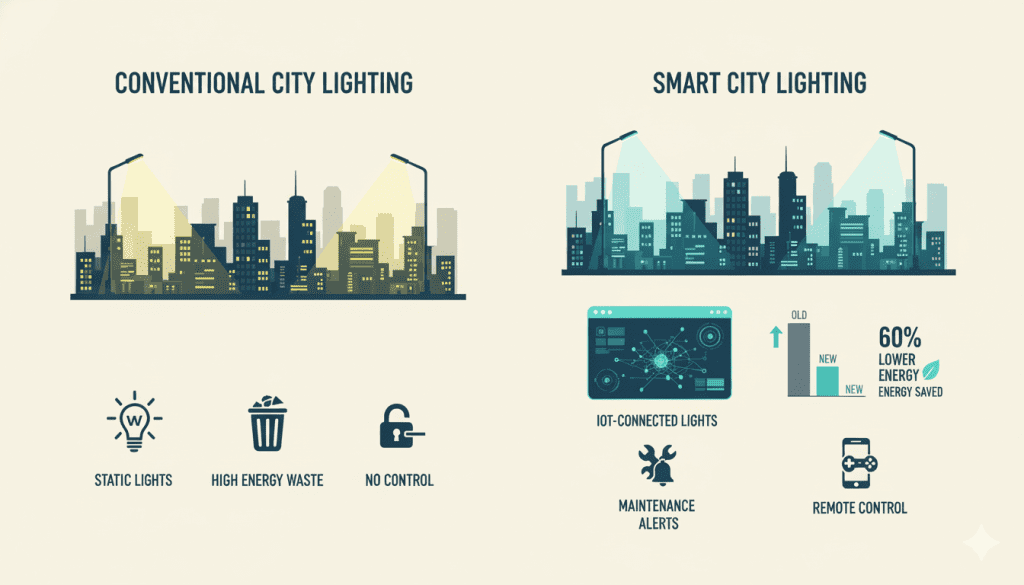
Every IoT transformation starts with something visible and impactful — smart streetlights.
They combine immediate ROI with community visibility:
| Feature | Traditional System | IoT Smart Lighting |
| Operation | Manual / Timed | Automated via sensors |
| Control | On-site | Remote & central |
| Energy Use | Unmonitored | Up to 45% lower |
| Maintenance | Reactive | Predictive |
For private townships and campuses, these are entry-point projects that pay for themselves within 18–24 months.
Smart Meters: The Backbone of Resource Transparency
Streetlights might open the door, but smart meters keep the place running.
They’re changing the game for billing, analytics, and sustainability:
– Automatic readings every few minutes
– Real-time dashboards for everyone — developers, tenants, whoever needs it
– Spot-on load management and instant fault detection
Take Lodha Palava City. They’ve got over 25,000 IoT meters tracking energy live — no more manual errors, and they’re saving over ₹2 crore a year just by balancing loads better.
The Economics of Smart Infrastructure
IoT systems reduce operational costs and deliver clear ROI:
| Metric | Traditional Infra | IoT-Driven Infra |
| Energy Cost | 100% baseline | 60–70% |
| Maintenance | Reactive | Predictive |
| Visibility | Fragmented | Unified dashboard |
| ROI Period | — | 1.5–2 years |
In private developments, this efficiency translates directly into lower CAM costs and higher tenant satisfaction — both vital to competitive positioning.
Real Deployments in India
| Project | Location | IoT Use | Outcome |
| Lodha Palava | Mumbai | Smart meters, lights | 45% energy saving |
| Infosys Campuses | Pune, Bengaluru | Smart grid + HVAC | 37% energy saving |
| GIFT City | Gujarat | Citywide IoT infra | 30% lower usage |
| Phoenix MarketCity | Bengaluru | Smart metering | 25% less wastage |
Integration Possibilities
IoT doesn’t work in a silo. It’s the digital backbone that ties all the other automation together:
– Solar power management
– Water and waste monitoring
– Security systems
– EV charging and smart parking
Each piece adds more value, making it easier for developers to build truly connected spaces.
Why Private Developers Can’t Ignore IoT
Here’s why IoT is non-negotiable now:
– Regulations are all about ESG and sustainability
– Investors and residents want more transparency
– Maintenance and energy waste eat into profits
– Power costs and crowded cities aren’t going away
IoT helps developers jump straight over these problems, building automation right into the infrastructure from the start.
Implementation Roadmap for Developers
Here’s how to get started:
1. Begin with smart streetlights — cheapest and most noticeable
2. Add smart meters for electricity and water
3. Bring all the data together in one dashboard
4. Set up automated alerts and predictive maintenance
5. Integrate solar and building management systems for complete control
Each step delivers real results, and you only invest as you go.
Future Outlook: Private Smart Grids
Coming soon: private townships and industrial parks running their own microgrids — self-sufficient, AI-powered, always on.
IoT is the glue connecting renewables, storage, and everything that uses energy, all in real time.
What used to be cutting-edge “smart city” stuff is about to become the new normal for every big private project.
Key Takeaways
Smart Infrastructure 2.0 = Data + Automation + Insight
IoT delivers actual ROI — in energy savings, better visibility, and easier maintenance
Private developers like GIFT City, Lodha, Mahindra, Infosys are already leading the charge
Start with basics (streetlights, meters), get to full automation faster
IoT makes private infrastructure ready for whatever comes next